
Module 5: Measuring wellbeing
Purposes of wellbeing measurement frameworks
Many places now use wellbeing measurement frameworks - both at national and local levels - to monitor progress towards wellbeing goals, with community and civil society organisations playing a vital role in co-creating them. Wellbeing measurement frameworks help to [1]:
Concretise a wellbeing vision, by specifying what good looks like for the desired wellbeing outcomes in the wellbeing vision
Monitor progress and to evaluate the effectiveness of interventions
Identify areas of strength as well as areas of challenge
Strengthen accountability, enabling people to gauge progress towards stated goals.
Over the last two decades, many international wellbeing measurement frameworks have been developed. Examples include the Sustainable Development Indicators, the OECD Well-being framework, the Human Development Index (HDI), the Genuine Progress Indicator (GPI), the Social Progress Index (SPI) and many more. For a comprehensive overview of wellbeing and ‘beyond GDP’ dashboards and indicators that have been developed by countries and researchers around the world, have a look at the Beyond GDP website, hosted by Leiden University (the Netherlands).
While there are variations between the precise indicators included, there is broad overlap in the domains that are generally reflected in wellbeing measurement frameworks [3]. Nearly all wellbeing measurement frameworks resonate with the philosophy set out in the seminal 1987 Brundtland report Our Common Future, which defined sustainability as “meeting the needs of the present without compromising the ability of future generations to meet their own needs”. The Brundtland report identified three dimensions of societal success:
Current wellbeing
Inclusion or the distribution of wellbeing
Sustainability or future wellbeing
These three dimensions feature across wellbeing frameworks internationally.
Case studies
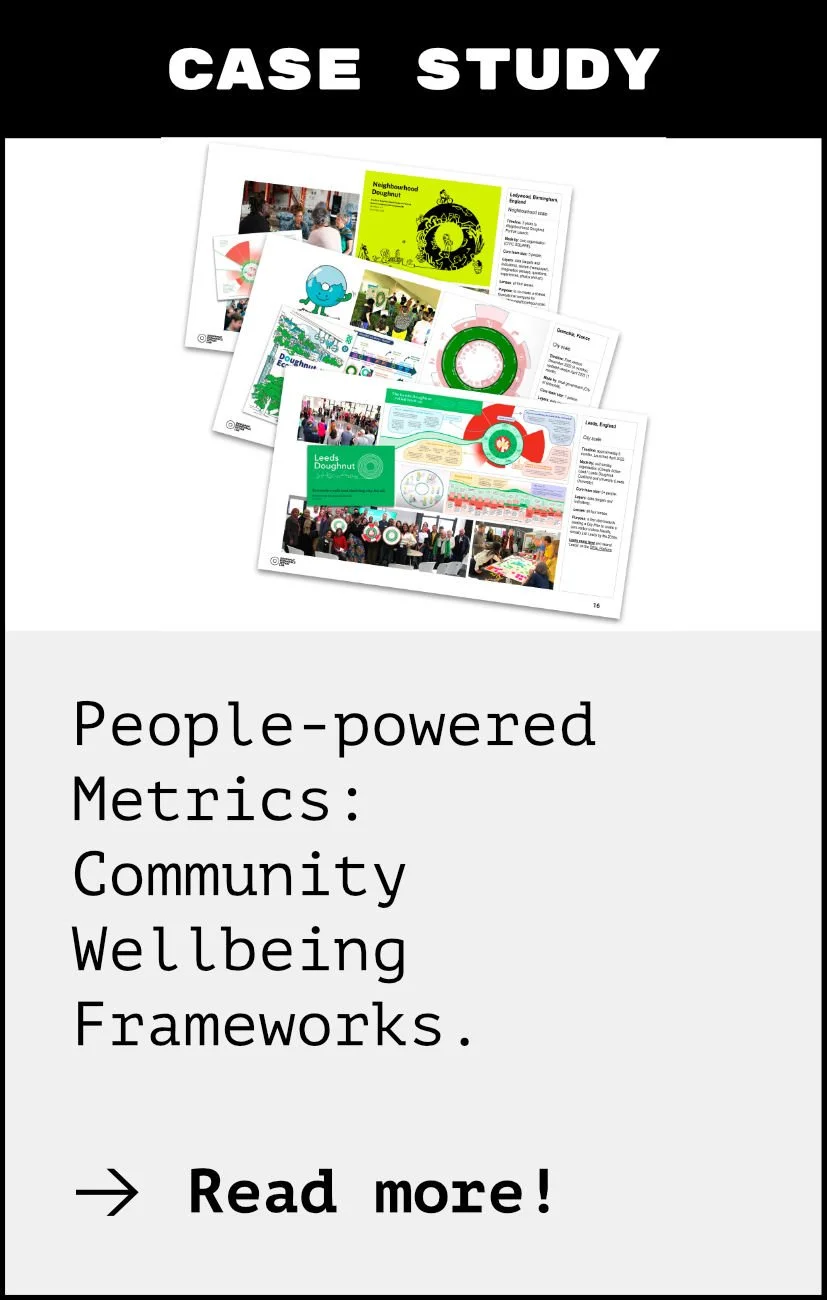
The card on the left showcases government wellbeing frameworks from around the world. But wellbeing measurement isn’t just for governments! Many community organisations and universities have engaged in wellbeing measurement too, for example using the Doughnut Data Portrait methodology. Dive into these examples by clicking on the case study card on the right.

References
[1] Abdallah, S., Laurence, R., Pickett, K., Hough-Stewart, L. Coscieme, L. (2024). Wellbeing Economy Ideas for Cities: Lessons for Implementation. Journal of City Climate Policy and Economy, 2 (2): 189-203, https://doi.org/10.3138/jccpe-2023-0018
[2] OECD (2023). Economic Policy Making to Pursue Economic Welfare: OECD Report for the G7 Finance Ministers and Central Bank Governors, May 2023, Japan, OECD, Paris.
[3] Zeidler, L. (2023). The Shared Ingredients for a Wellbeing Economy. Centre for Thriving Places, www.centreforthrivingplaces.org/wp-content/uploads/2023/02/Shared-Ingredients-for-a-Wellbeing-Economy-Paper_Publication-Copy.pdf